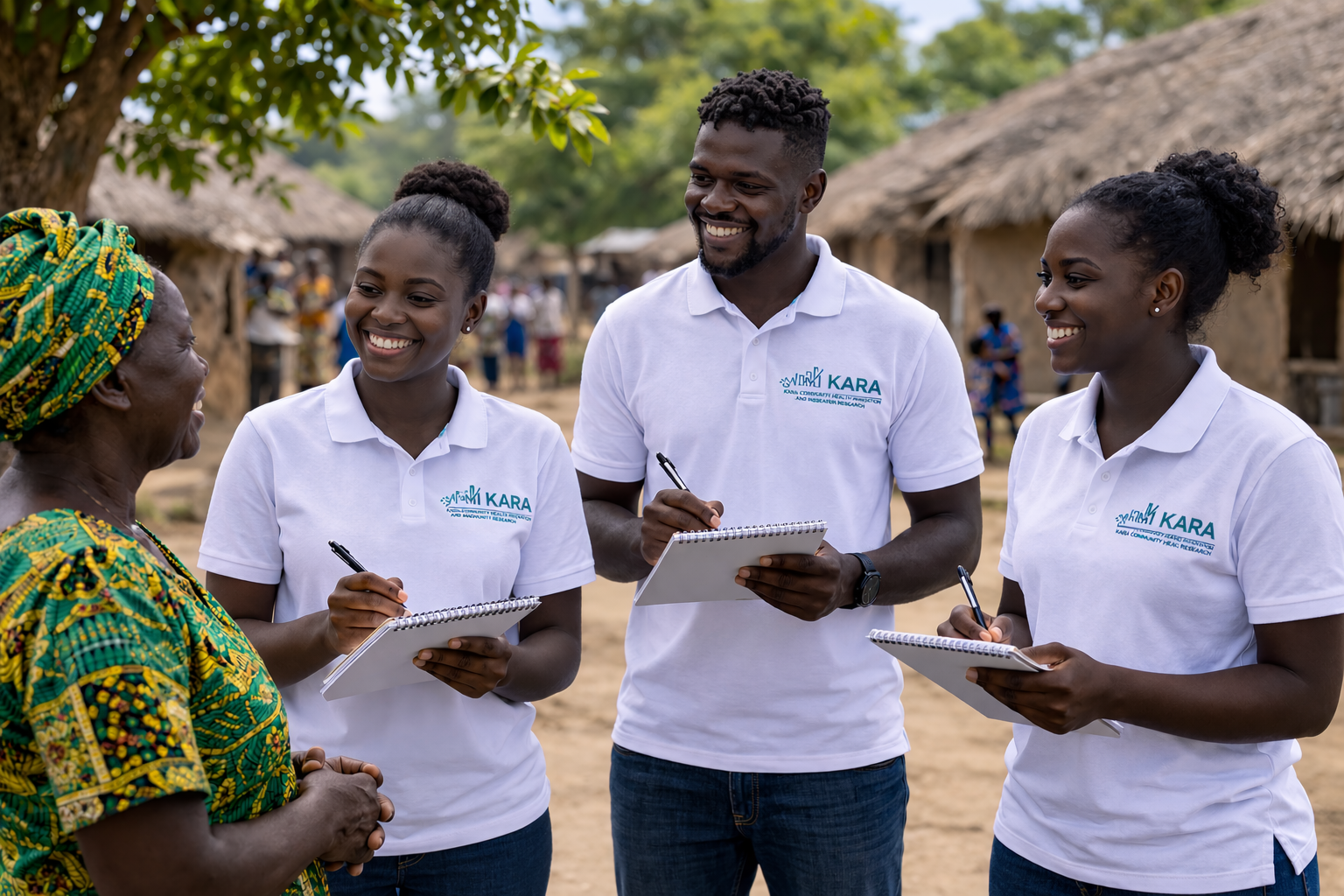
KARA field team members meeting with community members in a village setting

Community Health and Innovation Research

Generating transformative evidence
with communities

Bridging the gap between grassroots reality and formal planning through rigorous people-centred participatory research across Uganda.

About Us

Documenting the Evidence of Human Potential

KARA Community Health and Innovation Research is a Ugandan-based organization dedicated to a singular, transformative principle: Generating transformative evidence with communities.

We believe that every community holds the answers to its own challenges. These truths are often lost in the gap between grassroots reality and formal planning. Our mission is to bridge that gap. By combining rigorous scientific inquiry with a deeply people-centred participatory approach we move beyond traditional data collection to provide a voice for the lived experiences of households across Uganda.

Our Mission

To transform the landscape of community well-being by conducting participatory research that validates local challenges and co-creates sustainable health nutrition food security and housing.

Our Approach

We combine rigorous scientific inquiry with a deeply people-centred participatory approach to surface lived experiences and strengthen community-informed planning across Uganda.

Our Motto

"Generating transformative evidence with communities"

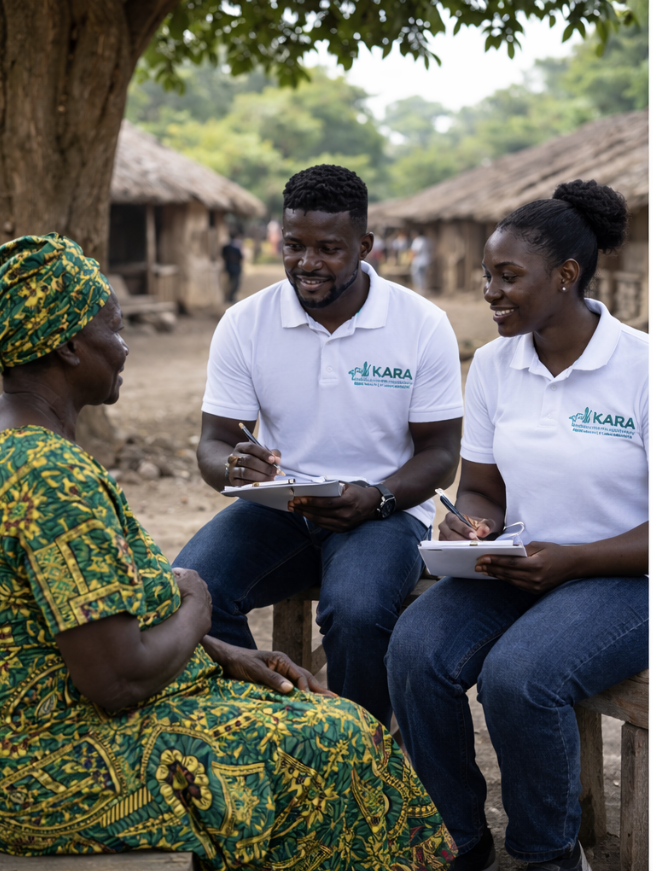
KARA team members listening to an elder during a field conversation

Our Core Pillars

What We Do

Six interconnected pillars drive our mission to validate community realities and catalyze evidence-based change.

We bridge the gap between grassroots lived experience and high-level policy through a rigorous participatory approach.

01

Participatory Community Diagnostics

We conduct deep-dive research into the health and economic pulses of communities by involving residents as co-researchers. Using specialised research frameworks we empower communities to self-document their challenges. This ensures the data we collect is grounded in local reality.
02

Livelihood Resilience & Asset Mapping

Our work involves investigating local economic systems indigenous knowledge and agricultural practices to validate community assets. Through comprehensive mapping we identify existing health resources and economic strengths. We highlight the indigenous strategies that foster long-term resilience.

03

Health Drivers & Equity Analysis

We look beyond symptoms to research the social determinants of health such as water access sanitation and nutrition to understand the why behind illness. This equity-focused analysis provides decision-makers with the insights needed to address root causes rather than only outcomes.

04

Knowledge Translation & Advocacy

Data is only powerful when it is understood. We specialise in synthesising complex findings into Technical Evidence Briefs. These are high-quality actionable reports designed to help planners and development partners translate field research into effective resource allocation.

05

Accountability & Program Verification

We ensure that development initiatives deliver on their promises through independent assessment and continuous feedback loops. By maintaining transparent communication between design teams and community outcomes we provide a vital layer of collaborative program verification.

06

Technical Capacity Building & Mentorship

Sustainability is rooted in local empowerment. We train community leaders women and youth in data literacy and digital tools. This equips them with the mentorship needed for evidence-based advocacy. Through facilitated alignment forums we create a neutral space where communities and stakeholders can reach a shared understanding for lasting change.

Our Goals

Strategic Objectives

Three focused objectives guide how we turn field evidence into practical action for lasting community change.

1

Evidence Community Realities

Conduct rigorous participatory research to document and validate lived experiences regarding health housing and economic stability. We move beyond data points to surface the human truth behind the statistics.

2

Map Resilience & Assets

Identify and analyze indigenous knowledge local skills and community resources that drive livelihood security. We focus on what communities have to build sustainable bottom-up solutions.

3

Bridge the Data-to-Policy Gap

Translate complex field findings into accessible Technical Evidence Briefs and actionable recommendations. We create neutral evidence-led platforms that align community priorities with stakeholder planning.